Charities That Help With Cremation Costs: 2026 Programs, Amounts and How to Apply

A cremation can be arranged for a few hundred dollars or for several thousand, and the difference has almost nothing to do with the cremation itself. That single fact is the most useful thing a grieving family can know in the first forty-eight hours, because it changes who you call first.
This guide covers the money side of cremation specifically: the benefits a family may already be owed, the state and county programs that pay crematories directly, the charities that genuinely fund cremation for a child or an infant, the one route that costs nothing at all, and the federal rule that gives you the right to decline everything you do not want.
Scope note. This is not a repeat of our broader guide to charities that help with funeral costs, which covers general funeral assistance organizations and burial. This page stays on cremation: what it costs, who pays for it, and the decisions that are specific to a cremation rather than a burial. If you are weighing burial, start with that guide instead.
What a cremation actually costs in 2026
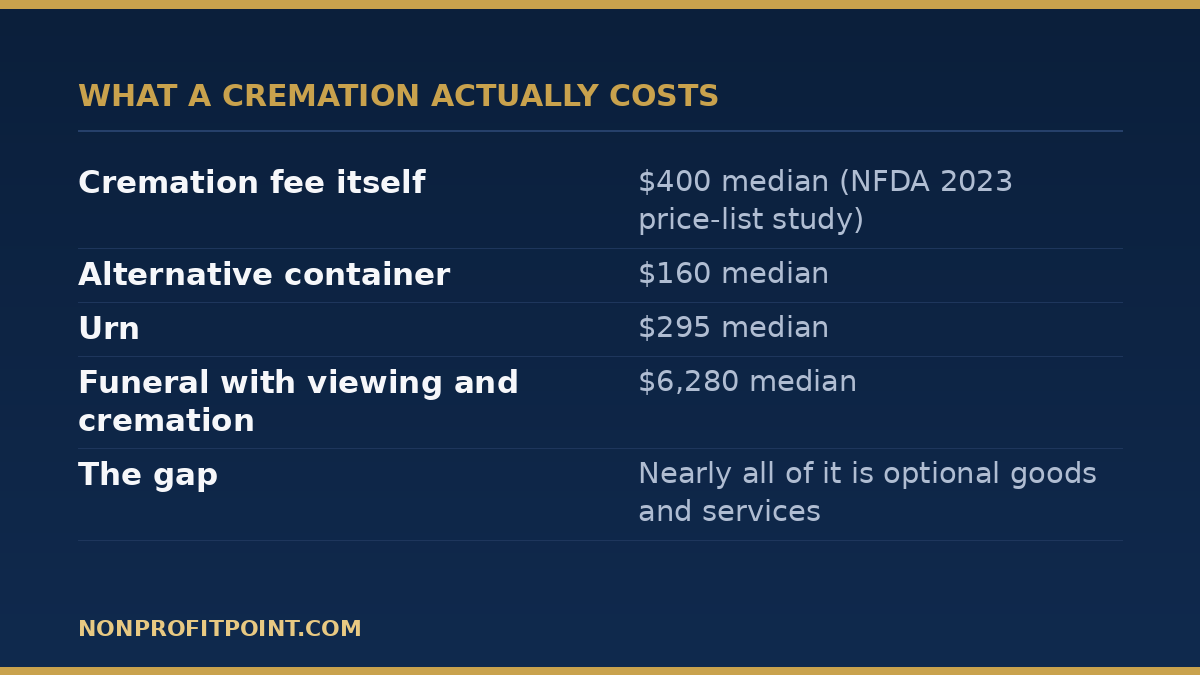
The National Funeral Directors Association tracks median prices from funeral home general price lists. In its 2023 General Price List Study, the median cremation fee itself was $400. A median alternative container — the simple fiberboard or composition container a body is cremated in — was $160. A median urn was $295.
In the same study, the median cost of a funeral with viewing and cremation was $6,280. The arithmetic is worth sitting with. The cremation, the container and the urn together come to roughly $855. Everything between that figure and $6,280 is optional goods and services: viewing, embalming, facility use, staff time, a rental casket, printed materials, transportation beyond the first removal.
None of that is a scandal. Families often want a viewing and are glad to pay for one. But when the question is how do we pay for this at all, the answer usually starts by separating the cremation from the ceremony. A direct cremation — no viewing, no embalming, no service with the body present — is the lowest-cost legal disposition in most of the country, and a memorial gathering can happen later, anywhere, for whatever the family can afford.
Cremation is also now the majority choice. The NFDA projected a 63.4% US cremation rate for 2025, and expects cremation to reach 82.3% by 2045. That matters practically: providers compete on cremation pricing in a way they did not fifteen years ago, and the spread between the cheapest and most expensive direct cremation in the same metro area can be several hundred percent.
The route that costs nothing: whole-body donation
This is the option most families have never heard of, and it is the only one that reliably reduces the bill to zero. Accredited whole-body donation programs accept a donor for medical research and education, and in exchange they pay for transportation from the place of death, the cremation, and the return of the cremated remains to the family.
MedCure covers transportation from the place of passing, cremation, and a certified death certificate at no cost to the donor or family. MedCure states there is no upper age limit for donors. Disqualifying factors include HIV or AIDS, hepatitis B or C, a history of intravenous drug use, recent incarceration or institutionalization, and being significantly over or under weight at the time of death. Cremated remains are returned in about five months, though timing varies by case. Families arrange a donation at the time of death by calling 1-866-560-2525, which is staffed 24 hours a day.
United Tissue Network covers transportation, cremation, return of the cremated remains and two certified copies of the death certificate. UTN says most people qualify, that communicable diseases such as HIV or hepatitis may disqualify a donor, and that each case is evaluated individually. Remains are typically returned within four to six weeks. The 24-hour line is 1-877-738-6111.
Many university medical schools also run willed-body programs on similar terms, usually with tighter geographic limits and a preference for pre-registration.
Be honest with yourself about the trade-offs. There is no viewing with the body present. The wait for ashes is weeks at best and months at worst, so a scattering or interment has to be planned around that. Acceptance is never guaranteed — a program can decline at the time of death, which is why families who choose this route should have a fallback provider identified. And some families have religious or personal objections to donation, which is a complete answer and needs no justification.
Benefits the family may already be owed
Before looking for a charity, check whether the person who died generated an entitlement. These are claims, not gifts, and they are routinely left unfiled.
VA burial allowance and national cemetery interment
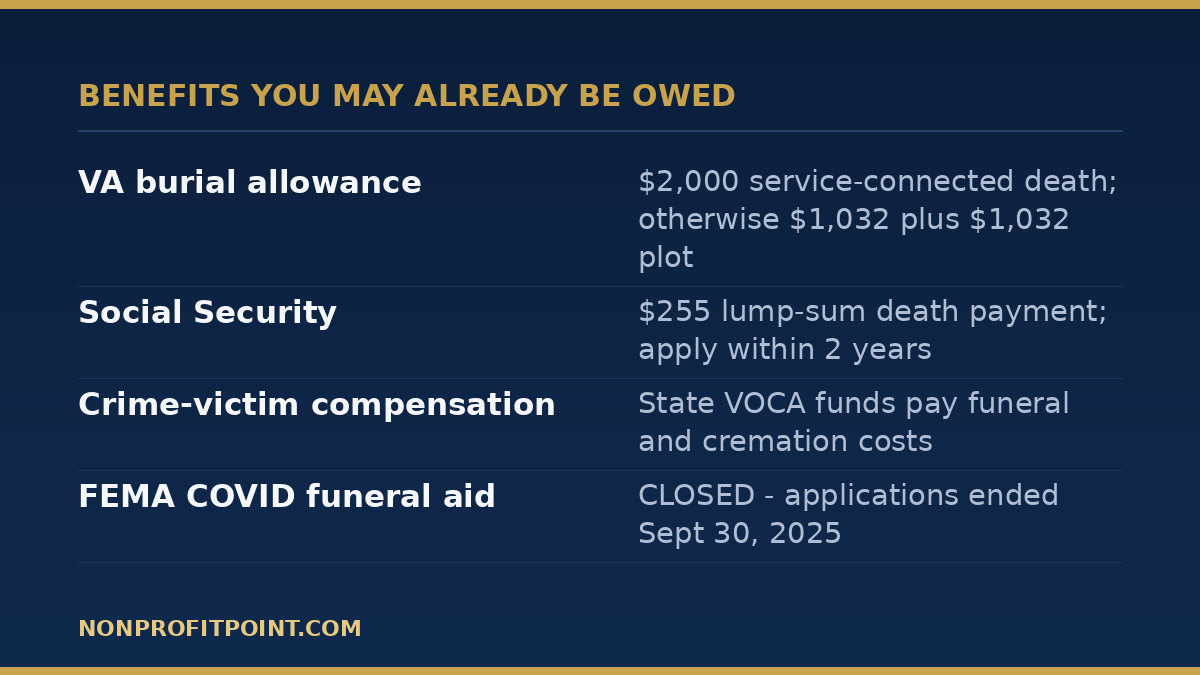
For a veteran, the Department of Veterans Affairs pays a burial allowance that can be applied to cremation. For a service-connected death on or after September 11, 2001, the maximum allowance is $2,000; for a service-connected death before that date, $1,500. For a non-service-connected death, the rates effective October 1, 2026 are a $1,032 burial allowance plus a $1,032 plot or interment allowance. The VA may also reimburse the cost of transporting the remains to a national cemetery when the veteran was hospitalized at a VA facility, was in a VA-contracted nursing home, or died while traveling to authorized care.
Apply with VA Form 21P-530EZ or online at VA.gov. There is no time limit for a service-connected death claim. For a non-service-connected death, file within two years of burial, with exceptions for deaths under VA care and for plot or transportation claims.
Separately, an eligible veteran can be interred at a national cemetery at no cost, and that includes interment of cremated remains in a columbarium niche or a scattering area. The grave or niche, the opening and closing, a marker and perpetual care are provided. For a family facing a cremation bill, this removes the entire cost of final placement.
Social Security lump-sum death payment
Social Security pays a one-time lump-sum death payment of $255. It is payable to a surviving spouse or a child who meets the program requirements, and survivors must apply within two years of the date of death. The amount is small and has not changed in decades, but it is a two-minute phone call and it is yours.
Crime-victim compensation when the death was a homicide
Every state operates a victim compensation program, and funeral and burial expenses — including cremation — are a standard covered category. These are the most under-claimed funds in this entire guide, largely because families do not know they qualify.
California is a useful illustration of how the money actually moves. The California Victim Compensation Board covers funeral and burial expenses for direct and derivative victims, caps total reimbursement to a victim at $70,000, and generally will not reimburse expenses submitted more than three years after they are incurred. CalVCB does not publish its funeral and burial sub-cap on its main benefits page; Los Angeles County child welfare policy records the figure available through CalVCB for a crime-related death as $7,500. The lesson generalises: the sub-cap is usually buried in a benefits reference guide, so call the program and ask rather than guessing from a website.
FEMA COVID-19 funeral assistance is closed
This one is in nearly every older article on the subject and it is now out of date. FEMA ran a COVID-19 Funeral Assistance program paying up to $9,000 per funeral, and its own guidance stated that FEMA would continue to provide funeral assistance until September 30, 2025. That date has passed. Do not build a plan around it, and treat any page that still presents it as open as a page that has not been checked.
State and county programs that pay crematories directly
This is where most real money for a cremation comes from in the United States, and it is paid at the county or state level rather than by a national charity. The amounts are modest, the paperwork is specific, and the deadlines are short. Four concrete examples show the shape of it.
New York City — HRA Office of Burial Services
New York City pays up to $1,700 toward a funeral bill for low-income residents. If the funeral bill exceeds $3,400, the cost of the burial plot, grave opening or cremation is deducted. Proof of need can include receipt of HRA cash assistance, SNAP benefits or Social Security benefits. The person responsible for arrangements, or their authorized representative, must complete the Burial Allowance Application, form M-860W, within 120 days of the date of death.
Indiana — Medicaid burial assistance
Indiana pays $1,200 toward funeral expenses and $800 toward cemetery expenses, a $2,000 ceiling, where the person who died was enrolled at the time of death in one of six Medicaid categories: MA A, MA D, MA DW, MA B, MA SI or MA R. The family does not file. Only funeral homes and cemetery representatives can file state form 35937, and the claim packet must be filed in proper form within 90 days of the date of death. Indiana township trustees may offer additional assistance to low-income or indigent residents.
Pennsylvania — Department of Human Services
Pennsylvania DHS will pay for burial and cremation services for people who received Supplemental Security Income or DHS cash benefits before death. Eligibility is determined through the local County Assistance Office, and the payment amounts live in the Office of Income Maintenance manuals rather than on the public page — so the figure has to be confirmed with the CAO. Funeral directors can reach DHS enrollment at 1-800-537-8862, option 3.
Los Angeles County — a child in county care
Where a child or nonminor dependent dies while receiving AFDC-FC or ARC payments, Los Angeles County reimburses funeral costs up to $12,818 effective July 1, 2026, on affidavit DCFS 835-A submitted with invoices through the Children’s Social Worker. Kin-GAP funeral expenses are capped at $5,000. Where no other funding applies, Net County Costs operate as funding of last resort.
How to find the program where you live
Three calls will usually find it. Call 211 and ask specifically for indigent cremation or burial assistance in your county. Call the county coroner, medical examiner or public administrator and ask what happens when a family cannot pay — that office administers the indigent disposition program in many counties and will tell you the threshold. Call the county or township social services office and ask for the burial or funeral assistance caseworker by name. In most places the funeral home that holds the body already knows which program applies and can file for you; ask them before you ask anyone else.
Charities that specifically fund cremation
Here is the part most articles on this topic get wrong by omission. For adults, there is very little national charitable money that pays a cremation bill outright. The assistance that exists is overwhelmingly for infants and children, is often limited by chapter and by available funds, and is usually paid to the funeral home rather than to the family. Knowing that saves days of fruitless calling.
The TEARS Foundation
TEARS runs several named funds for pregnancy, infant and child loss. The Luca John Fund provides financial funeral assistance for babies from 20 weeks gestation up to one year old, with funding limited to availability. Charlie and Braden covers funeral assistance for children aged 1 to 12 who die from external causes. Cali’s Gift supports families of those aged 13 to 22 whose death involved drug-related causes or suicide. TEARS states it responds to funeral assistance inquiries within 48 hours. Phone 253-200-0944; email admin@thetearsfoundation.org. Amounts are not published and depend on the fund and on availability, so ask directly.
Children’s Burial Assistance
Children’s Burial Assistance serves families who have lost a child from birth through age 21 and are experiencing financial hardship. It offers donated burial plots and urns subject to availability and location, and — the more broadly useful service — it connects families to funeral homes, crematories and cemeteries that have agreed to provide reduced or at-cost services. The organization is explicit that it is not an insurance supplement and does not cover full funeral expenses. Submit the form on its site; confirmation follows in 24 to 48 hours. Phone (980) 480-8282; email info@childrensburialassistance.org.
Final Farewell
Final Farewell serves Pennsylvania families who have lost a child aged 18 or younger, providing financial assistance when available along with advice and guidance on arrangements, to families of all religions and backgrounds. Services are free of charge. Phone (215) 870-8110, Monday to Friday, 9:00am to 4:00pm.
What to do if the person who died was an adult
Work the list in this order: the benefits section above, then the county indigent program, then the funeral home itself. Ask the funeral director directly whether they have a hardship rate or a payment plan, and ask a second and third provider for their direct cremation price before you sign anything. Faith communities, fraternal organizations, unions and employers frequently have small discretionary death-benefit funds that are never advertised. Crowdfunding works for some families and not for others, and it works best when one friend runs the campaign rather than the bereaved.
The FTC Funeral Rule is your strongest lever
Federal law gives you specific rights at a funeral home, and the rights are worth more than most of the grants above. The Funeral Rule is enforced by the Federal Trade Commission and applies to every funeral provider in the country.
- You can get the prices in writing, from anyone who asks. A provider “must give the General Price List to anyone who asks, in person, about funeral goods, funeral services, or the prices of such goods or services.”
- You can get prices by phone. A provider “must give consumers who telephone your place of business and ask about your prices or offerings accurate information from your General Price List.” You do not have to walk in to compare.
- Embalming is not required. The mandated disclosure reads: “Embalming is not required by law. Embalming may be necessary, however, if you select certain funeral arrangements, such as a funeral with viewing.” For a direct cremation it is not necessary.
- You can use an alternative container. The required disclosure states: “If you want to arrange a direct cremation, you can use an alternative container. Alternative containers encase the body and can be made of materials like fiberboard or composition materials.”
- Nobody can tell you the law requires a casket. A provider “cannot tell consumers that state or local law requires them to buy a casket if they are arranging a direct cremation.”
Used properly, these five rights are worth more than every charity on this page combined. Call four providers, ask each for the direct cremation price including the container and the crematory fee, and write the four numbers down. In most metropolitan areas the spread between the lowest and the highest will be larger than any grant you could win.
What to do in the first 48 hours
- Decide whether you need a viewing with the body present. If not, you are looking for a direct cremation and the bill drops by thousands immediately.
- If whole-body donation is acceptable to the family, call a program now. MedCure at 1-866-560-2525 or United Tissue Network at 1-877-738-6111, both 24 hours. Acceptance has to be decided quickly.
- Phone four providers for a direct cremation price. They must quote you over the phone. Ask what is included and what the crematory fee is.
- File the benefit claims. VA Form 21P-530EZ if the person was a veteran; Social Security for the $255; the state victim compensation program if the death was a homicide.
- Call 211 and the county public administrator and ask what the county does when a family cannot pay.
- If a child died, call TEARS, Children’s Burial Assistance and, in Pennsylvania, Final Farewell. Have the date of death, the age, and the funeral home name ready.
- Do not sign a contract on the first visit unless the price is already the lowest of the four you gathered.
A note on timing and on being kind to yourself
Nothing here has to be decided in an hour. A funeral home can hold a body while a family makes calls, a county program can be applied for after the fact in many places, and the VA claim can be filed up to two years out. The pressure to decide immediately is almost always commercial rather than legal. Slow down by one day and the numbers in this guide tend to move in your favour.
Related help
- Charities That Help With Funeral Costs — the broader guide, covering burial and general funeral assistance organizations.
- Charities for Infant Loss — grief support and assistance after the death of a baby.
- Charities That Help Widows — financial and practical help after the death of a spouse.
- Charities That Help With Medical Bills — for the medical debt that often precedes a death.
- Charities That Help Seniors With Bills — programs for older adults facing a cost they cannot meet.
- Charities That Pay Rent Directly — for households destabilised by a death in the family.
Frequently Asked Questions
Do any charities pay the full cost of a cremation?
Rarely, and almost never for an adult. The charities that fund cremation outright are focused on infants and children, pay the funeral home rather than the family, and are limited by available funds. For adults, the money usually comes from benefit entitlements and county indigent programs instead.
What is the cheapest legal way to be cremated in the United States?
Whole-body donation to an accredited medical research program, which covers transportation, cremation and return of the ashes at no cost to the family. The next cheapest is a direct cremation with no viewing, no embalming and an alternative container, bought from the lowest-priced of several providers you phone for quotes.
Will the county cremate a body if the family cannot pay?
In most places some county, township or state program exists for an indigent disposition, but the rules, the amounts and the office that runs it vary widely. Call 211, the county coroner or public administrator, and the county social services office. The funeral home holding the body usually knows which program applies and can file for you.
Does Social Security pay for cremation?
Social Security pays a one-time lump-sum death payment of $255 to a surviving spouse or a child who meets the requirements. Survivors must apply within two years of the date of death. It is not a funeral benefit and it will not cover a cremation on its own.
How much does the VA pay toward a veteran cremation?
For a service-connected death on or after September 11, 2001 the maximum burial allowance is $2,000. For a non-service-connected death the rates effective October 1, 2026 are a $1,032 burial allowance plus a $1,032 plot or interment allowance. Apply with VA Form 21P-530EZ. Interment of cremated remains at a national cemetery is provided at no cost for eligible veterans.
Is FEMA still paying for COVID funeral and cremation costs?
No. FEMA COVID-19 Funeral Assistance paid up to $9,000 per funeral, and FEMA guidance stated the agency would continue to provide that assistance until September 30, 2025. That deadline has passed, so the program should not be counted on.
Can you donate a body to science and get a free cremation?
Yes. Accredited whole-body donation programs such as MedCure and United Tissue Network cover transportation, cremation and return of the cremated remains at no charge. MedCure returns remains in about five months and United Tissue Network typically within four to six weeks. Both operate 24-hour lines and acceptance is decided case by case.
Can a funeral home require you to buy a casket for cremation?
No. Under the FTC Funeral Rule a provider cannot tell consumers that state or local law requires them to buy a casket if they are arranging a direct cremation, and must make an alternative container available. Embalming is also not required by law for a direct cremation.
How long do you have to apply for burial or cremation assistance?
Deadlines are short and they differ by program. New York City requires its burial allowance application within 120 days of death. Indiana requires the funeral home to file within 90 days. Social Security allows two years, and the VA allows two years from burial for a non-service-connected death with no limit for a service-connected death.
Does cremation have to happen immediately?
No. A funeral home can hold a body while a family gathers quotes and files claims, and most assistance programs can be applied for after arrangements are made. The pressure to decide within hours is commercial rather than legal, and taking an extra day usually lowers the bill.
Sources and how this guide was checked
Figures on this page were taken from primary sources and checked in October 2026: the Department of Veterans Affairs burial allowance page for the rates effective October 1, 2026; the Social Security Administration publication on survivors benefits for the $255 lump-sum payment; the Federal Trade Commission Funeral Rule compliance guidance for consumer rights; FEMA COVID-19 Funeral Assistance guidance for the September 30, 2025 end date; the NFDA 2023 General Price List Study for median prices and the NFDA media center for the projected cremation rate; the NYC Human Resources Administration, the Indiana Division of Family Resources, the Pennsylvania Department of Human Services and Los Angeles County DCFS policy for the state and county program terms; and the published program pages of MedCure, United Tissue Network, The TEARS Foundation, Children’s Burial Assistance and Final Farewell. Where a program does not publish an amount, this guide says so rather than estimating. Program terms change; confirm amounts with the program before relying on them.