IVF Grants 2026: 14 Programs That Help Pay for Fertility Treatment

A single round of IVF is, for most American families, the largest medical bill they will ever pay out of pocket in one go — and unlike a hospital stay, there is usually no insurer standing behind it. The result is a peculiar kind of financial cruelty: a treatment that works is sitting right there, and the only thing between a family and it is money.
There is real money available. Not enough of it, and not easy to get, but real. Foundations award IVF grants ranging from a few thousand dollars to a fully donated treatment cycle. Fifteen states require insurers to cover IVF. Veterans with service-connected infertility have a statutory benefit most of them do not know exists. Cancer patients can often preserve fertility at a quarter of list price.
The problem is that this money is scattered across dozens of small organisations, each with its own deadline, its own eligibility test, and its own paperwork — and many of the lists you will find online are stale, padded with defunct programmes, or quietly repeating dollar figures nobody has checked in years.
This guide is the opposite of that. Every programme below was checked against the organisation’s own website while writing. Where an organisation does not publish a figure, this guide says so rather than inventing one. Where a deadline has already passed, it is listed as the published cycle so you know the rhythm of the programme rather than being sent to a dead link.
What you are actually up against
Before the programme list, three facts that should shape how you plan.
IVF is priced per cycle, and most people need more than one. Clinics quote a “cycle” price that typically covers monitoring, egg retrieval, fertilisation and one transfer. Medications are usually billed separately and can add thousands. Genetic testing of embryos, intracytoplasmic sperm injection (ICSI), embryo storage, and donor eggs or sperm are all separately priced on top. A quote you are given over the phone is nearly always the floor, not the ceiling — ask the clinic’s financial counsellor for an itemised estimate that includes medication, anaesthesia, and storage, in writing.
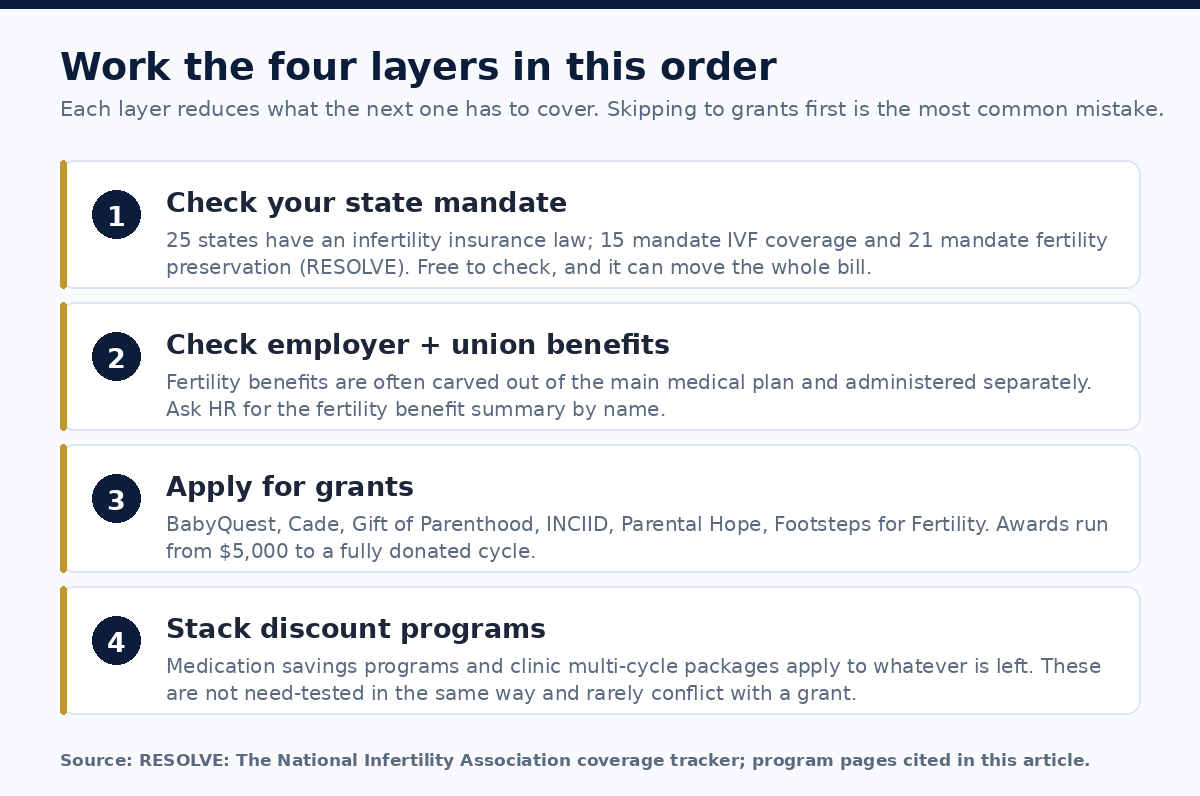
Insurance coverage is a lottery decided by your ZIP code and your employer. According to RESOLVE: The National Infertility Association, which maintains the running tracker, there are currently 25 states with infertility insurance laws, 15 states with IVF mandates to cover, and 21 states with fertility preservation mandates. The states named on RESOLVE’s tracker are Arkansas, California, Colorado, Connecticut, Delaware, Florida, Georgia, Hawaii, Illinois, Kentucky, Louisiana, Maine, Maryland, Massachusetts, Montana, Nevada, New Hampshire, New Jersey, New York, Ohio, Oklahoma, Rhode Island, Texas, Utah and Washington, D.C. Counts differ between sources because some tally laws that merely require insurers to offer coverage; the American Society for Reproductive Medicine’s patient FAQ, for instance, states that “Twenty-two states and the District of Columbia currently have laws that require insurers to either cover or offer to cover some form of infertility diagnosis and treatment.” Both are true; they are counting slightly different things.
Grant money is smaller than the bill, and that is fine. Very few awards cover a full cycle. The realistic goal is to stack: a state mandate or employer benefit takes the biggest bite, a grant covers a slice, a medication savings programme covers another, and you finance or save for what is left. Families who treat grants as the whole answer tend to apply to one programme, get declined, and stop. Families who treat grants as one layer of four tend to get somewhere.
National IVF grants and fertility treatment grants
These programmes accept applicants from across the United States. They are the first place to look, and also the most competitive — applicant pools run into the thousands for award counts in the dozens.
1. BabyQuest Foundation
What it funds: BabyQuest provides financial assistance for “IVF (in vitro fertilization), gestational surrogacy, egg and sperm donation (with IVF), egg freezing, and embryo donation (with IVF).”
Track record: The foundation reports $4 million-plus awarded, 300-plus grants, and 230-plus babies born.
Eligibility: BabyQuest states that “Grants are available to singles and couples, both same-sex and heterosexual.” Requirements include U.S. permanent residency and treatment at an accredited U.S. fertility facility; a documented medical need for intervention such as IVF, donor gametes or surrogacy; “overall good physical and mental health”; adequate housing (you must lease or own your residence); basic health insurance with prenatal coverage; and — a requirement that surprises many applicants — “at least one partner must maintain employment.” You cannot have started medications or procedures before applying, and there is a maximum of two lifetime applications.
Cost to apply: A “Non-refundable Application Fee of $75.”
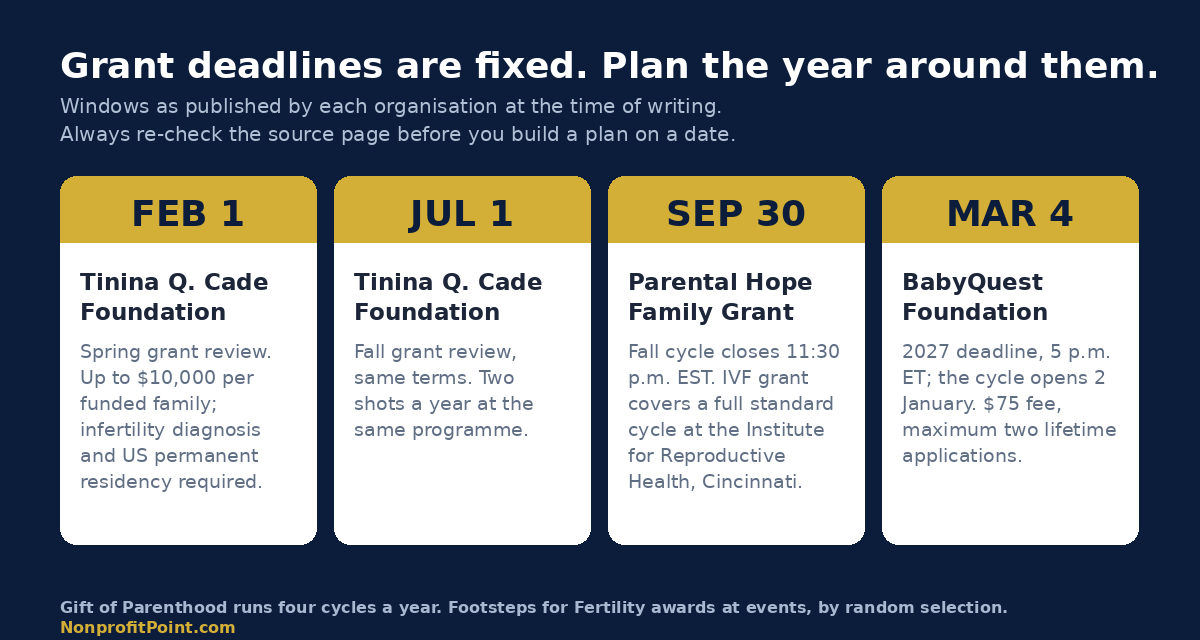
Cycles and deadlines: Grants are awarded twice yearly, in spring and fall cycles. At the time of writing, the foundation lists a next deadline of March 4, 2027 at 5 p.m. ET, with the grant cycle opening January 2. Note that BabyQuest also sets a deadline to start an application roughly a week before the submission deadline — do not leave it to the final days.
What the application involves: An 18-section online form, a medical evaluation from your fertility specialist, a personal story capped at 1,000 words, insurance cards, and the fee. “All applicants will be notified via email approximately four to six weeks after the application deadline.”
Where to apply: babyquestfoundation.org/apply
2. The Tinina Q. Cade Foundation — Family Building Grant
What it funds: The Cade Foundation grant assists “with costs of domestic adoption and medical fertility treatment” — one of the few programmes that treats adoption and treatment as a single family-building need rather than forcing applicants to choose a lane.
Award size: “Up to $10,000 per funded family.“
Eligibility: Two hard requirements, both stated in capitals on the foundation’s own page: “You MUST have a diagnosis of infertility from your doctor” and “You MUST be a legal permanent US resident.”
Deadlines: “February 1 for the Spring grant review and July 1st for the Fall Grant Review.” Two review rounds a year means that if you miss one, the next is roughly five months out — worth calendaring the moment you read this.
Cost to apply: The foundation states that “Grant Application registration fees are NON REFUNDABLE.” The fee amount is not published on the page reviewed here; confirm it with the foundation before you budget for it.
Where to apply: cadefoundation.org/family-building-grant
3. Gift of Parenthood
What it funds: “IVF, fertility treatment, adoption, surrogacy, and other paths to parenthood.”
Award size: Applicants can “Apply for up to $20,000, awarded through application review” — the largest published individual award ceiling among the national programmes reviewed here.
Frequency: “The Gift of Parenthood Grant Program runs four grant cycles a year.” Four cycles is a meaningful advantage: a decline in one cycle is a three-month wait rather than a six-month one, and you can act on feedback quickly.
Cost to apply: $75 for the optional grant programme — but the organisation waives that fee for applicants who raise their first $250 through its fundraising component. If you have any willing network at all, that is a fee you should never pay.
Where to apply: giftofparenthood.org/grant
4. INCIID — the “From INCIID the Heart” IVF Scholarship
This one is structurally different from the others, and for the right applicant it is the single most valuable award on this list.
What it funds: “Approximately $25,000 in the form of donated medical care” — the IVF procedure itself, donated by a participating clinic, rather than a cash grant.
What it does not fund — read this carefully: The scholarship “typically excludes pre-cycle work-ups, anesthesia, most medications, donor services, embryo freezing, PGD testing, and services from providers outside the donating clinic.” Those exclusions are not trivial. Medication alone can run into thousands. Budget for them as a separate line even if you win.
Eligibility: A U.S. resident who files IRS tax returns; a registered INCIID community member at the “Bronze level of annual support from applicants by (donating $55 annually)”; a medical infertility diagnosis meeting American Society for Reproductive Medicine standards; a letter from a reproductive specialist documenting medical necessity; and no IVF insurance coverage. INCIID also notes explicitly that “Tubal ligation (tied tubes) is not considered medical infertility but is a sterilization procedure” — reversal-related cases do not qualify.
Income test: “Generally, a household income of $75,000 or below is considered enough need but other circumstances are also considered.” INCIID says higher incomes may still qualify where cost of living, depleted savings, or the need for genetic procedures changes the picture — so a household somewhat above that line should not self-reject.
Timing: Recipients are matched to a clinic based on clinic availability rather than proximity — you may be travelling. INCIID is candid that “The timelines can be lengthy and are dependent on many other individuals, participating clinics and companies working with us.” This is not the programme to rely on if you are working against a clinical deadline.
Where to apply: inciid.org/ivf-scholarship
5. Parental Hope — Family Grant
What it funds: Three distinct grants, which is unusual and useful:
- IVF Grant — “Covers the full cost of a standard IVF cycle to include one egg retrieval, one embryo transfer (frozen or fresh), intracytoplasmic sperm injection (if medically necessary), and IVF education day fee.”
- Frozen Embryo Transfer Grant — “Covers the full cost of one frozen embryo transfer (‘FET’).” Valuable if you already have embryos in storage and the transfer itself is the barrier.
- Embryo Adoption & Donation Grant — “Provides a one-time payment of up to $5,000.”
The catch, and it is a real one: the IVF and FET grants are performed at “the Institute for Reproductive Health in Cincinnati, OH,” and the embryo adoption grant works with “the National Embryo Donation Center located in Knoxville, Tennessee.” If you do not live within reach of Cincinnati or cannot travel repeatedly for monitoring, this grant is far less practical than its headline suggests. Retrieval cycles require frequent in-person monitoring over roughly two weeks.
Track record: 122 grants awarded, $1 million in funds awarded, 70 babies born from grant recipients, with 4 more on the way at the time of writing.
Deadline: “Grant Applications are due by 11:30 p.m. EST on September 30th” for the fall cycle.
Where to apply: parentalhope.org/parental-hope-family-grant-2
6. Footsteps for Fertility Foundation
What it funds: Two award types — “In-Kind Donations – Provided by SART-recognized clinical partners, covering in-house clinic costs for a basic IVF cycle” and “Monetary Grants – Typically $5,000, awarded when funding permits.”
How recipients are chosen — this is the important part: “All grants are awarded through a random selection held immediately following each event. With every event registration, participants receive one complimentary ticket entered into the selection on behalf of the applicant they are supporting.”
That structure changes the strategy entirely. Footsteps for Fertility is not a merit competition where a better essay wins; it is closer to a raffle in which your odds scale with how many people register for the event in your name. If you have a network willing to sign up for a 5K, this is the programme where that network converts most directly into odds. A national application is also offered periodically, also by random selection.
Cost to apply: No application fee is stated; event registration provides the complimentary entry.
Where to apply: footstepsforfertility.org
Fertility preservation help for cancer patients
If infertility is a consequence of cancer treatment — what clinicians call iatrogenic infertility — you are in a different and considerably better-funded category. Two things are true here that are not true elsewhere: the programmes are better resourced, and the clock is brutal, because preservation has to happen before chemotherapy or radiation begins. If you have just been diagnosed, make these calls this week, not next month.
7. Livestrong Fertility
What it offers: Livestrong Fertility partners with clinics to provide “at least 25% off services for eligible patients,” and through a partnership with EMD Serono, qualifying patients receive complimentary fertility stimulation medication — often the single largest line item in a preservation cycle.
Scale: The organisation reports a network of “150+ fertility clinics & cryobanks,” over 17,000 people served, and “$100M saved by patients in preservation expenses.”
Eligibility: Lawful U.S. presence; a confirmed cancer diagnosis with oncologist involvement; agreement from the oncology team that treatment affects fertility; selection of a partner clinic; and demonstrated financial need.
Income limits — note that these are generous by the standards of this field, and that they differ by whether you are the birthing parent:
- Birthing parents: $130,000 or less (single) or $170,000 or less (married)
- Non-birthing parents: $101,000 or less (single) or $130,000 or less (married)
How to start: Complete the checklist, gather documentation, and call the programme at (855) 844-7777 for case management support. Speak to a human here — the case managers know which partner clinics have current capacity.
Where to apply: livestrong.org/what-we-do/program/fertility
8. The Chick Mission — Hope Grants
What it funds: Direct financial support for fertility preservation. The organisation’s stated mission is “to ensure every young woman newly diagnosed with cancer has the option to preserve fertility through direct financial support, educational programs, and advocacy efforts.”
Track record: 936 Hope Grant recipients and $12,580,000 saved in medical expenses for patients and families, with the organisation working toward 1,000 grants awarded.
Eligibility: “Newly diagnosed female patients choosing to preserve fertility options ahead of treatment.” The programme focuses on young women and young adults; a specific age range is not published.
A practical note: The Chick Mission does not publish deadlines or per-grant amounts, and asks prospective applicants to “contact us for more information about where we work geographically and our current fertility partners across the country.” Geography matters here — call before you plan around it.
Where to apply: thechickmission.org
Cutting the medication bill
9. EMD Serono Fertility LifeLines
Fertility medications are where budgets quietly break. A stimulation protocol is priced separately from the cycle at most clinics, and the number can rival the procedure itself. Manufacturer programmes are the most underused tool in this entire guide, largely because patients assume they will not qualify.
What it offers: Three separate routes — “Fertility Instant Savings, Compassionate Care, or Compassionate Corps programs for self-pay patients who qualify.” The organisation states that “You could save up to thousands of dollars on your EMD Serono Fertility medication,” and that “Your specific circumstances, including financial need and military status, help determine how much you may save.”
What that structure means in practice: Fertility Instant Savings is the broad tier with a quick decision. Compassionate Care is the deeper-discount tier and requires “Patient financial or tax documentation.” Compassionate Corps is the military route. Because the tiers are assessed together from one questionnaire, there is no downside to applying — the system routes you to the best programme you qualify for.
How to enrol: Answer the eligibility questions for an instant decision, supply financial documentation if you are being assessed for Compassionate Care, then use the savings card at a partner pharmacy. Programme line: 1-866-LETS-TRY (1-866-538-7879).
Where to apply: fertilitysavings.com
Ask your clinic’s financial counsellor which manufacturer supplies your specific protocol before you enrol — other manufacturers run comparable programmes, and the right one depends on which drugs you have been prescribed. The same logic that governs charities that help with prescription costs generally applies here: the manufacturer programme is nearly always more generous than a discount card, and the two are worth comparing rather than assuming.
Benefits you may already have and not know about
Before you pay a single application fee, spend an afternoon on this section. The money here is larger than anything a foundation will award you, and you do not have to compete for it.
10. VA fertility and IVF benefits for veterans
This is the most valuable and most overlooked benefit in the entire field, and the eligibility rule is narrower than most people assume in one direction and wider in another.
What VA covers for all veterans using VA health care: “History and physical exam,” “Laboratory tests,” “Imaging services such as ultrasounds and X-rays,” “Hormonal therapies for gonadal stimulation,” and “Surgical treatments for conditions affecting fertility.”
What VA covers for veterans with service-connected infertility: “ART/IVF, including counseling, evaluation, and treatment,” with a “Veteran’s lifetime benefits of up to 6 attempts to create embryos for up to three completed embryo transfer cycles,” plus “Cryopreservation of sperm, eggs, and embryos.”
The eligibility test: Veterans must have “a VBA-adjudicated service-connected disability or treatment of a VBA-adjudicated service-connected disability that is causally related to their infertility.” The chain matters: the service-connected condition, or its treatment, has to be what caused the infertility. A service-connected condition unrelated to reproduction does not unlock the benefit.
On marital status — the point most commonly got wrong: “A Veteran’s marital status is not a factor in determining their eligibility for VA ART/IVF benefits.” Spouses, however, are covered only if legally married to an eligible veteran.
What is excluded: The cost of obtaining donor eggs, sperm or embryos, and “fertility preservation for delayed childbearing alone” — VA covers preservation only where medical treatment could cause infertility.
The Secretary of Veterans Affairs issued “Instructions for Determining Eligibility for In Vitro Fertilization (IVF) Benefit” dated March 28, 2024, which clarified the standards; if you were told no before that date, it is worth asking again.
Where to start: womenshealth.va.gov/topics/fertility-services.asp, and ask your VA primary care team for a reproductive health referral by name.
11. State insurance mandates
If you live in one of the 15 states with an IVF mandate, your first call is not to a foundation — it is to your insurer, with a specific question. Mandates do not apply universally within a state: they typically bind fully insured plans regulated by the state, and do not reach self-funded employer plans governed by federal ERISA rules. Large employers frequently self-fund. So the question to ask your HR department is not “does my state require IVF coverage” but “is our plan fully insured or self-funded?” — that single answer tells you whether the mandate reaches you.
Mandates also differ enormously in what they require: some cap the number of cycles, some impose a prior-treatment requirement, some exclude certain diagnoses, and some cover only fertility preservation for patients facing medically induced infertility. RESOLVE’s state-by-state tracker is the place to read your own state’s actual terms rather than a summary of them.
12. Employer and union fertility benefits
Fertility benefits have spread quickly through large employers, and they are frequently administered by a third-party vendor rather than showing up in the main medical plan documents. That is why so many employees conclude they have no coverage when they do.
Ask your HR or benefits team three specific questions: whether the plan includes a fertility or family-building benefit administered by a separate vendor; what the lifetime maximum is and whether it is expressed in dollars or cycles; and whether the benefit requires pre-authorisation or use of a specific clinic network. Ask in writing, and ask for the benefit summary document rather than a verbal answer. If your spouse or partner is employed elsewhere, run the same three questions against their plan — coordinating two benefits is common and legitimate.
Options that are not grants but often matter more
Clinical trials
Fertility clinics attached to academic medical centres run studies that sometimes provide treatment at substantially reduced cost or at no cost in exchange for participation. Trials have strict inclusion criteria — age bands, diagnosis, prior treatment history, body mass index — and you will not qualify for most of them, but the ones you do qualify for can be transformative. Search ClinicalTrials.gov for “in vitro fertilization” filtered to recruiting studies in your state, and ask your reproductive endocrinologist directly whether their practice is enrolling. Read the informed consent document carefully: understand what is covered, what is not, and what happens if the cycle is cancelled.
Multi-cycle and refund programmes
Many clinics offer packages that bundle two or three retrieval cycles at a discount against paying per cycle, and some offer refund or “shared risk” programmes that return a portion of your money if you do not have a live birth. These are financial products, not charity, and they deserve the scepticism you would give any financial product. Get the terms in writing and read specifically for: what counts as a completed cycle, what happens if a cycle is cancelled before retrieval, whether medications are included (usually not), whether the refund is partial or full, and what disqualifies you from the refund. A package priced against three cycles is only a saving if you would genuinely have done three.
Medical loans and fertility-specific financing
Lenders market fertility-specific loans aggressively, and some clinics have preferred lending partners. Compare the APR against a credit union personal loan before you sign anything — the convenience of a clinic-arranged loan is frequently priced into the rate. Watch for deferred-interest structures, where interest accrues from day one and is charged retroactively if the balance is not cleared inside a promotional window. If you are already carrying medical debt, read our guide to charities that help with medical bills before adding to it.
Regional and condition-specific programmes worth checking
Beyond the national programmes above, a layer of smaller state- and region-specific foundations awards fertility grants, often with far less competition because far fewer people know about them. Award terms at organisations this size change frequently and several do not publish current amounts, so this guide names them as leads to check directly rather than quoting figures that may be stale:
- Hope for Fertility Foundation — national grant programme; contact via hopeforfertility.org.
- Journey to Parenthood — grants for fertility treatment and adoption.
- Starfish Infertility Foundation — Indiana-focused fertility grants.
- Kevin J. Lederer Life Foundation — Illinois-area fertility assistance.
- Fertility Foundation of Texas — Texas-focused treatment grants.
- Nest Egg Foundation — Connecticut-area fertility grants.
- Pay It Forward Fertility Foundation — grants funded through community fundraising.
- Team Maggie’s Dream — fertility preservation support for adolescent and young adult cancer patients.
- The Samuel Fund — support for young adults facing cancer, including fertility-related costs.
Two search strategies find more of these than any list can. First, search your state name plus “fertility grant” plus “foundation” — regional programmes rarely rank nationally and are genuinely hard to find otherwise. Second, ask your clinic’s financial counsellor which foundations their patients have successfully used. Counsellors see the outcomes across hundreds of patients a year and know which programmes actually disburse. That question, asked directly, is worth more than an hour of searching.
How to apply: a working sequence
Applications are long, repetitive and emotionally taxing. Doing them in the right order cuts the work substantially, because the same documents serve almost every programme.
Step 1 — Build the document pack once. Nearly every application asks for the same things: the most recent federal tax return and W-2s, recent pay stubs, a letter from your reproductive endocrinologist documenting the infertility diagnosis and medical necessity, an itemised treatment cost estimate from your clinic, proof of U.S. residency or citizenship, insurance cards, and a personal statement. Assemble all of it in one folder before you open a single application form. This single step is the difference between applying to six programmes and applying to one.
Step 2 — Write the personal statement properly, once. BabyQuest caps its story at 1,000 words; other programmes vary. Write the long version first, then cut to each programme’s limit. Reviewers read hundreds of these. What distinguishes the memorable ones is specificity — the actual timeline, the actual diagnosis, the actual numbers, the actual decisions you have already made and what they cost — not intensity of feeling. Avoid generic language about dreams and journeys; every applicant has those, and they carry no information.
Step 3 — Get the medical letter early. Physician letters are the most common cause of a missed deadline, because they depend on someone else’s schedule. Request it three to four weeks out, provide your doctor’s office with a short bullet list of what the programme requires, and follow up at the two-week mark.
Step 4 — Confirm every eligibility requirement before you pay a fee. The requirements that most often disqualify applicants after they have paid are the quiet ones: BabyQuest’s employment requirement and its rule that you cannot have started medications or procedures; INCIID’s requirement that you have no IVF insurance coverage and be a paying member; Cade’s permanent-residency requirement; Parental Hope’s clinic location. Read the eligibility page twice and check yourself against each line.
Step 5 — Apply to every programme you qualify for, in the same season. Grant programmes generally do not penalise applying elsewhere, and award rates at competitive national programmes are low enough that a single application is close to a coin flip with bad odds. The marginal effort of a fifth application, once the document pack exists, is an hour.
Step 6 — Calendar the cycles you miss. Cade reviews on February 1 and July 1. BabyQuest opens January 2 for a March deadline. Parental Hope closes September 30. Gift of Parenthood runs four cycles a year. If you miss one, put the next in your calendar the same day with a three-week advance reminder, because you will not remember in five months.
Step 7 — If you are declined, ask what would strengthen a future application. Smaller foundations will sometimes tell you. Larger ones usually will not, but the question costs nothing and some programmes allow reapplication in a later cycle.
What makes an application competitive
Reading across the published criteria of these programmes, a consistent picture emerges of what reviewers are actually assessing — and it is not, as many applicants assume, simply who is poorest or who is saddest.
Demonstrated medical necessity, documented by a specialist. Every programme reviewed here requires a diagnosis from a reproductive endocrinologist, and several specify the standard: INCIID requires a diagnosis meeting American Society for Reproductive Medicine criteria. A letter that states the diagnosis plainly and explains why IVF specifically is indicated does more work than any other document in the pack.
Financial need, but paired with financial stability. This combination confuses applicants, and it is worth naming directly. BabyQuest requires that “at least one partner must maintain employment” and that applicants have adequate housing and basic health insurance with prenatal coverage. Livestrong sets income ceilings well into six figures. These programmes are not looking for destitution; they are looking for families who cannot self-fund a cycle but can support a child. Present your finances as constrained, not chaotic.
Readiness to proceed. Grants are awarded to families who will use them. A clinic selected, a treatment plan agreed, and a cost estimate in hand all signal that an award converts into a cycle rather than sitting idle. BabyQuest’s rule that you cannot have started medications or procedures before applying cuts the other way — be ready, but do not start.
Following instructions exactly. An 18-section form with a 1,000-word cap and a mandatory medical evaluation is, among other things, a filter. Applications that ignore word limits, omit requested documents or arrive after a stated cut-off are generally not read on their merits.
Warning signs worth taking seriously
Where money is scarce and desperation is high, predatory operations follow. A few rules that will keep you out of trouble.
Legitimate grant programmes do not guarantee an award in exchange for a fee. Modest, clearly disclosed application fees are normal and are used to manage volume — BabyQuest charges $75, Gift of Parenthood charges $75 and waives it for fundraisers, INCIID requires a $55 annual membership donation. What is not normal is a fee tied to a promise, a “processing fee” demanded after you have been told you won, or any request for payment by wire transfer, gift card or cryptocurrency.
Check the organisation’s tax status. U.S. charitable organisations are searchable in the IRS Tax Exempt Organization Search, and most established fertility foundations also have public profiles on Candid/GuideStar showing filed Form 990s. An organisation soliciting applications with no traceable filings deserves your scepticism.
Be wary of anyone who contacts you first. Grant programmes do not cold-call applicants, and they do not message you on social media offering funds. If you posted about your treatment publicly, assume that post is visible to people who target patients.
Never send original documents or full financial account numbers. Applications legitimately require tax returns and pay stubs, submitted through a secure portal. They do not require bank account numbers, routing numbers or card details — awards are typically disbursed directly to the clinic, not to you.
Related help with medical and family costs
Fertility treatment rarely arrives as an isolated expense. These guides cover the costs that tend to sit alongside it:
- Charities that help with medical bills — for balances already owed, including hospital charity care policies most patients never ask about.
- Charities that help with prescription costs — patient assistance foundations and manufacturer programmes for ongoing medication.
- Organizations that help cancer patients financially — essential reading alongside the fertility preservation section above.
- Charities that help with adoption costs — several foundations on this page fund adoption and treatment from the same application.
- Free transportation for medical appointments — relevant if your grant sends you to a clinic in another city.
- Charities that help mothers and babies — for the stretch after a successful cycle.
- Charities and support for miscarriage and pregnancy loss — support that exists whether or not a cycle works.
Frequently asked questions about IVF grants
Can I apply to more than one IVF grant at the same time?
Yes. None of the programmes reviewed here prohibit applying elsewhere, and given how competitive national awards are, applying to a single programme is a poor strategy. The practical limit is your documentation: once you have assembled tax returns, pay stubs, a physician letter and a cost estimate, each additional application is largely a matter of reformatting the personal statement. What you should check is whether a programme restricts how many times you may apply overall — BabyQuest, for example, sets a maximum of two lifetime applications, so you want to use those attempts when your case is strongest.
Do IVF grants pay the money to me or to my clinic?
Almost always to the clinic. Several programmes do not disburse cash at all: INCIID’s scholarship is “approximately $25,000 in the form of donated medical care” provided by a participating clinic, and Footsteps for Fertility’s in-kind awards cover “in-house clinic costs for a basic IVF cycle” at SART-recognised partner clinics. Cash grants such as Parental Hope’s embryo adoption award, “a one-time payment of up to $5,000,” are the exception rather than the rule. Assume the award will be applied against your clinic bill, and treat any programme promising to deposit funds into your personal account as a red flag.
Is there an income limit for IVF grants?
It varies widely, and the limits are often higher than applicants expect. INCIID states that “generally, a household income of $75,000 or below is considered enough need but other circumstances are also considered,” explicitly leaving room for higher incomes where cost of living or depleted savings changes the picture. Livestrong Fertility sets ceilings of $130,000 for single birthing parents and $170,000 for married birthing parents, with lower thresholds of $101,000 and $130,000 for non-birthing parents. BabyQuest does not publish an income cap at all, but requires that at least one partner maintain employment and that applicants hold basic health insurance with prenatal coverage. Do not self-reject on income without reading the specific programme’s stated test.
What if I already have embryos frozen and only need a transfer?
You are in a better position than most applicants, and you should look specifically for transfer-only awards rather than full-cycle grants. Parental Hope runs a dedicated Frozen Embryo Transfer Grant that “covers the full cost of one frozen embryo transfer,” performed at the Institute for Reproductive Health in Cincinnati. A transfer is a far smaller ask than a full retrieval cycle, so more of the smaller regional foundations can fund one, and your odds improve accordingly.
Are there IVF grants for single people and same-sex couples?
Yes. BabyQuest states plainly that “Grants are available to singles and couples, both same-sex and heterosexual,” and funds egg and sperm donation alongside IVF and gestational surrogacy — the pathways most relevant to single and LGBTQ+ applicants. Gift of Parenthood funds “IVF, fertility treatment, adoption, surrogacy, and other paths to parenthood.” Where programmes do impose a barrier, it is usually indirect: a requirement for a medical infertility diagnosis meeting clinical criteria can be harder to satisfy where infertility is situational rather than diagnostic. Read each programme’s diagnosis requirement specifically, and ask the organisation directly if your situation is unclear.
Does the VA really cover IVF for veterans?
Yes, but on a narrow eligibility test. VA provides “ART/IVF, including counseling, evaluation, and treatment” with lifetime benefits of “up to 6 attempts to create embryos for up to three completed embryo transfer cycles,” plus cryopreservation of sperm, eggs and embryos. The requirement is a “VBA-adjudicated service-connected disability or treatment of a VBA-adjudicated service-connected disability that is causally related to their infertility” — the service-connected condition has to be the cause. Marital status does not affect a veteran’s own eligibility, though a spouse must be legally married to the veteran to be covered. Donor eggs, sperm and embryos are excluded, as is preservation for delayed childbearing alone. If you were assessed before the Secretary’s March 28, 2024 eligibility instructions, it is worth asking to be reassessed.
How long does it take to hear back after applying?
Expect weeks to months, and plan treatment timing accordingly. BabyQuest tells applicants they “will be notified via email approximately four to six weeks after the application deadline,” which is at the fast end. INCIID is candid that its “timelines can be lengthy and are dependent on many other individuals, participating clinics and companies working with us,” because awards depend on matching a recipient to a clinic with available capacity. If you are working against a clinical deadline — declining ovarian reserve, or cancer treatment starting — do not build your plan around a grant decision. For cancer-related preservation specifically, call Livestrong Fertility at (855) 844-7777 rather than waiting on a grant cycle.
Why do grant programmes charge an application fee?
Fees in the $55 to $75 range are used by small foundations to manage application volume and cover review costs — BabyQuest charges a “Non-refundable Application Fee of $75,” Gift of Parenthood charges $75 but waives it for applicants who raise their first $250 through fundraising, and INCIID requires a $55 annual membership donation as a condition of eligibility. These are disclosed up front and are normal. What is not normal is a fee demanded after you have been told you won, a fee that scales with the award size, or any request for payment by wire transfer, gift card or cryptocurrency. Those are the markers of a scam, not a foundation.
What should I do if I am declined?
Three things, in order. Reapply in the next cycle where the programme allows it — Gift of Parenthood runs four cycles a year and Cade reviews twice, so the wait is shorter than it feels. Widen the net to regional programmes, where applicant pools are dramatically smaller than at national foundations and where your state residency is an advantage rather than a neutral fact. And work the layers a grant was never going to cover on its own: confirm whether your employer plan is fully insured or self-funded, check your state’s mandate terms, enrol in a manufacturer medication savings programme, and ask your clinic’s financial counsellor which foundations their patients have actually received money from.
The honest summary
The money described on this page is real, and it has produced real children — BabyQuest reports 230-plus babies born, Parental Hope 70, The Chick Mission 936 preservation grants and $12.58 million saved. It is also, collectively, far smaller than the need. National programmes receive many times more qualified applications than they can fund, and a declined application says nothing about the strength of your case.
That is why the order of operations matters more than any single application. Check your state mandate and your employer plan first, because that is where the largest sums are and you do not compete for them. Apply to every grant you qualify for in the same season, using one document pack. Stack medication savings programmes on whatever remains. And if you are facing cancer treatment, make the fertility preservation calls this week — that window closes in a way the others do not.
Programme terms, deadlines and award amounts change. Every figure on this page was verified against the organisation’s own published material at the time of writing, and every programme is linked so you can confirm current terms before you build a plan around them. Do that check. Then apply.
About this guide. Researched and written by the NonprofitPoint editorial team. Every programme listed was verified against the organisation’s own published eligibility, award and deadline information at the time of writing, and linked so readers can confirm current terms directly. Where an organisation does not publish a figure, this guide says so rather than estimating. Last reviewed September 2026.
This is not medical, legal or financial advice. Eligibility rules, award amounts and application deadlines are set by each organisation and change without notice. Insurance mandate coverage depends on your specific plan type and state. Confirm current terms with the organisation, your insurer and your clinic before making treatment or financial decisions.