Charities That Help With School Clothes: 12 Real Programs (2026)

Getting kids ready for a new school year is expensive, and clothing is one of the biggest line items. Families routinely spend hundreds of dollars per child on new tops, bottoms, shoes, and a jacket before the first bell rings — money that many households simply don’t have on top of rent, utilities, and food. The good news: a real network of charities that help with school clothes exists specifically to close that gap, and most of it is free.
This guide lists 12 legitimate programs — national nonprofits, faith-based charities, government allowances, and school-based options — that provide free school clothing, shoes, and uniforms. For each one you’ll find who it helps, what you actually receive, the eligibility rules, and exactly how to apply. Program details below were verified against each organization’s official website and public program pages in July 2026.
How Free School Clothing Programs Work
Before you start applying, it helps to know that these programs generally fall into two models. Direct programs let you (or your child’s school) request help and receive clothing straight from the charity. Referral programs — including some of the largest nonprofits — don’t work with families one-on-one; instead they supply clothing in bulk to a network of partner agencies (schools, shelters, caseworkers), and you access the goods through a partner you’re already connected with. Knowing which model a program uses tells you whether to call the charity directly or ask your school or social worker to place the request.
“School clothes” assistance can cover new or gently used tops and bottoms, shoes, coats, underwear and socks, and — in many districts — school uniforms. Some programs give a physical package of clothing; others provide a voucher or a shopping event where kids pick out their own new outfits. Here are the programs worth your time.
12 Charities and Programs That Help With School Clothes
1. Assistance League — Operation School Bell
Operation School Bell is Assistance League’s signature program, and it’s the single best-known source of new school clothing for children in need. Depending on the local chapter, kids either shop for a set of brand-new clothes at an organized store event or receive a package of new clothing — commonly tops, bottoms, underwear, and socks, and often shoes, a jacket, and hygiene items.
Who qualifies: Eligibility is set by each local chapter but generally follows federal/HUD income guidelines for household size. Most chapters serve a specific grade band (commonly elementary through middle school, though some serve K–12), and school enrollment verification is required.
How to apply: You don’t apply directly — the program runs through participating schools. Ask your child’s school counselor, social worker, or front office whether the school partners with Assistance League’s Operation School Bell. The school submits the referral, and you’ll provide income documentation such as recent pay stubs. Learn more at assistanceleague.org.
2. National Giving Alliance
Founded in 1885 as the Needlework Guild of America, the National Giving Alliance (NGA) distributes brand-new clothing — never secondhand — to children and families in need, along with new toiletries and household linens. The organization and its predecessors have provided more than 127 million new garments over their history.
Who qualifies: Recipients must qualify as homeless or low-income under federal criteria. NGA works through partner agencies and school districts rather than serving families one-on-one.
How to apply: Access NGA clothing through one of its partner 501(c)(3) agencies or partner schools. Ask your school district, caseworker, or a local social-service agency whether they work with a National Giving Alliance branch. NGA runs a regional branch network plus 170+ affiliated agencies and 80+ partner schools, so availability depends on your area. Details at nationalgivingalliance.org.
3. Cradles to Crayons
Cradles to Crayons is the largest national nonprofit focused specifically on children’s clothing insecurity. It provides free clothing, shoes, and school supplies — packaged as “KidPacks” tailored to each child — to kids from birth through age 12 who are living in low-income or homeless situations.
Who qualifies: Two requirements: (1) your family or child must be actively working with a Cradles to Crayons Service Partner, and (2) household income must be within 200% of the Federal Poverty Line.
How to apply: Cradles to Crayons doesn’t serve families directly. It works through a network of Service Partners — schools, shelters, Head Start programs, caseworkers, and community health and housing agencies. Ask an agency you already work with, or your child’s school social worker, to place an order on your behalf. Direct-service hubs are in Boston, Chicago, and Philadelphia, with national reach through its Giving Factory Direct program. Visit cradlestocrayons.org.
4. Baby2Baby
Baby2Baby supplies children living in poverty with clothing, diapers, and basic necessities. It has distributed more than 450 million items and reaches over a million children a year across all 50 states through a network of nearly 1,000 partner agencies — a strong option for younger and school-age kids’ clothing and essentials.
Who qualifies: Access is through partner organizations, and many partners use income-based criteria. You cannot apply directly on Baby2Baby’s website.
How to apply: Receive items through a local partner you’re already connected with — a shelter, school, clinic, or social-service agency — or through community distribution events. Ask your caseworker or dial 211 to find which local agencies distribute Baby2Baby goods. More at baby2baby.org.
5. The Salvation Army
Many local Salvation Army corps run back-to-school programs each summer that provide school clothes, shoes, and supplies, and the Salvation Army also issues clothing vouchers redeemable for free clothing at its Family Stores year-round.
Who qualifies: Requirements vary by location, but many branches serve families at or below roughly 150% of the federal poverty level, with documentation of need required.
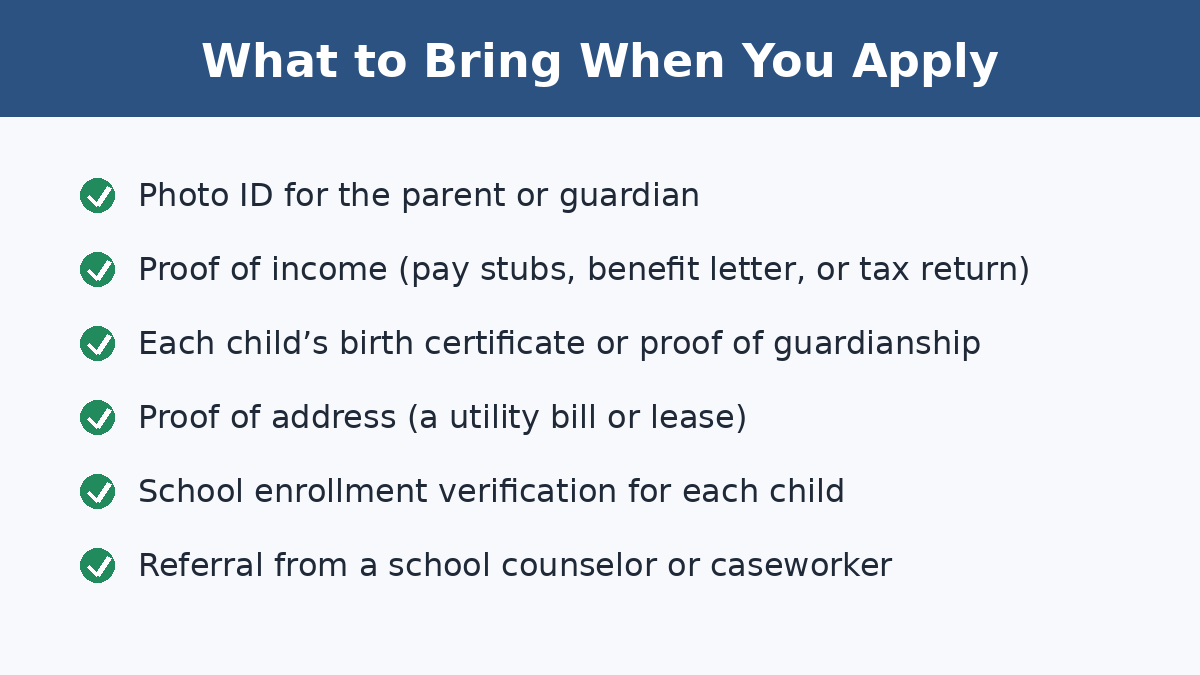
How to apply: Contact your nearest Salvation Army corps community center (not the thrift store) and ask for the social-services coordinator. Request a hardship assessment or ask about back-to-school registration, which often opens in June or July. Bring a photo ID, birth certificates for your children, proof of address, and proof of income or benefits. Find your location at salvationarmyusa.org.
6. St. Vincent de Paul & Catholic Charities
The Society of St. Vincent de Paul and Catholic Charities agencies operate local clothing closets and issue vouchers for free clothing — including children’s school clothes and shoes — through parish-based conferences and diocesan offices. St. Vincent de Paul alone runs thousands of local conferences nationwide, and you do not have to be Catholic to receive help.
Who qualifies: Generally low-income households; assistance is need-based and assessed locally.
How to apply: Find your local St. Vincent de Paul conference or Catholic Charities agency and call to ask about clothing assistance or vouchers. Many handle intake by phone or a brief home visit. Start at svdpusa.org or catholiccharitiesusa.org.
7. Operation Homefront — Back-to-School Brigade (Military Families)
For military families, Operation Homefront’s Back-to-School Brigade distributes free backpacks filled with school supplies at events nationwide each summer — a program now in its 19th year. It focuses on supplies and backpacks rather than clothing, but for eligible families it removes a major back-to-school expense so the budget can stretch to cover clothes.
Who qualifies: DEERS-enrolled military dependent children in grades K–12.
How to apply: Create or log into a MyOperationHomefront account and register for a Back-to-School Brigade event near you. Supplies are limited and events are first-come, first-served, running through the summer. Details at operationhomefront.org.
8. Your School District’s Clothing Closet & Counselor
Often the fastest, lowest-barrier option is right inside the school. Many public schools and districts run clothing closets stocked with new and gently used school clothes, shoes, coats, and sometimes uniforms — available quietly to students who need them.
Who qualifies: Typically any enrolled student in need. School staff handle it discreetly, frequently without formal income paperwork.
How to apply: Ask your child’s school counselor, social worker, or main office whether the school or district has a clothing closet or a partnership with a clothing charity. This single conversation often unlocks several of the programs on this list at once.
9. McKinney-Vento Homeless Liaison (Students Experiencing Homelessness)
The federal McKinney-Vento Homeless Assistance Act requires every public school district to have a homeless-education liaison, and McKinney-Vento funds can be used for clothing, school supplies, and other support so students can attend and take part fully. Importantly, “homeless” is defined broadly — it includes families doubled-up with others due to hardship, staying in motels or shelters, or unsheltered.
Who qualifies: Students who lack a fixed, regular, and adequate nighttime residence. These students also have the right to immediate enrollment (even without documents), to remain in their school of origin, and to transportation.
How to apply: Contact your school district’s homeless liaison — ask the front office or check the district website for the “McKinney-Vento” or “homeless education” contact. It’s free and confidential. Background and a directory are available at schoolhouseconnection.org.
10. Foster Care Clothing Allowances & Together We Rise
Children in foster care are generally entitled to a clothing allowance through the state or county child-welfare agency — both an initial allowance when a child is placed and ongoing support. On top of that, nonprofits such as Together We Rise provide foster youth with items like duffel bags, clothing, and comfort kits.
Who qualifies: Children in licensed foster care (allowance amounts vary by state), and their foster or kinship caregivers.
How to apply: Ask your child’s caseworker about the state clothing allowance and how reimbursement works. For supplemental clothing and back-to-school help, contact Together We Rise or a local foster-care nonprofit.
11. TANF School Clothing Allowance (State Cash Assistance)
TANF (Temporary Assistance for Needy Families) is federally funded but state-run, and several states pay a dedicated back-to-school clothing allowance for eligible children. Recent examples show how much this can be worth: Massachusetts (through TAFDC) paid $500 per eligible child in September 2025; New Mexico pays a $100 August clothing allowance plus $50 in January per child; Oregon sends up to $270 per year for clothing across May, August, and November; and West Virginia runs a standalone School Clothing Allowance. Names and amounts vary by state.
Who qualifies: Families enrolled in the state’s TANF or cash-assistance program (income-based). Some states pay the allowance automatically to enrolled families; others require a request.
How to apply: Contact your state’s TANF or Department of Human/Social Services office and ask specifically about a back-to-school or children’s clothing allowance for 2026. If you’re not currently on TANF, ask whether your household is eligible. Start at usa.gov/welfare-benefits.
12. 211, Buy Nothing & Freecycle (Hyperlocal and Peer-to-Peer)
When you need help fast or the big programs are full, go local. Dialing 211 (or visiting 211.org) connects you with a specialist who can find back-to-school clothing programs, vouchers, and distribution events in your ZIP code — often ones that never appear in a web search. For free peer-to-peer clothing with no application at all, Buy Nothing groups and Freecycle let neighbors give kids’ clothes, shoes, and coats directly.
Who qualifies: 211 helps anyone; Buy Nothing and Freecycle are open to all.
How to apply: Call 211 or visit 211.org; search “Buy Nothing [your town]” on Facebook, or join your local group at freecycle.org.
Clothes are only half the back-to-school list. See our companion guides to free school supplies for kids and free winter coats, and if money is tight across the board, our Get Help Paying For… directory maps every assistance program in one place.
How to Apply for School Clothing Assistance, Step by Step
You’ll get more, faster, by working these steps in order rather than applying to programs at random.
1. Start at your child’s school. Ask the counselor or social worker about Operation School Bell, a school clothing closet, and — if your family is in an unstable housing situation — the McKinney-Vento liaison. School staff often know every local program and can refer you the same day.
2. Call 211 for a local map. A 211 specialist can pull together the clothing programs, vouchers, and back-to-school events in your ZIP code, including small church and community efforts that don’t advertise online.
3. Gather your documents. Most programs ask for the same paperwork. Having it ready speeds up approval.
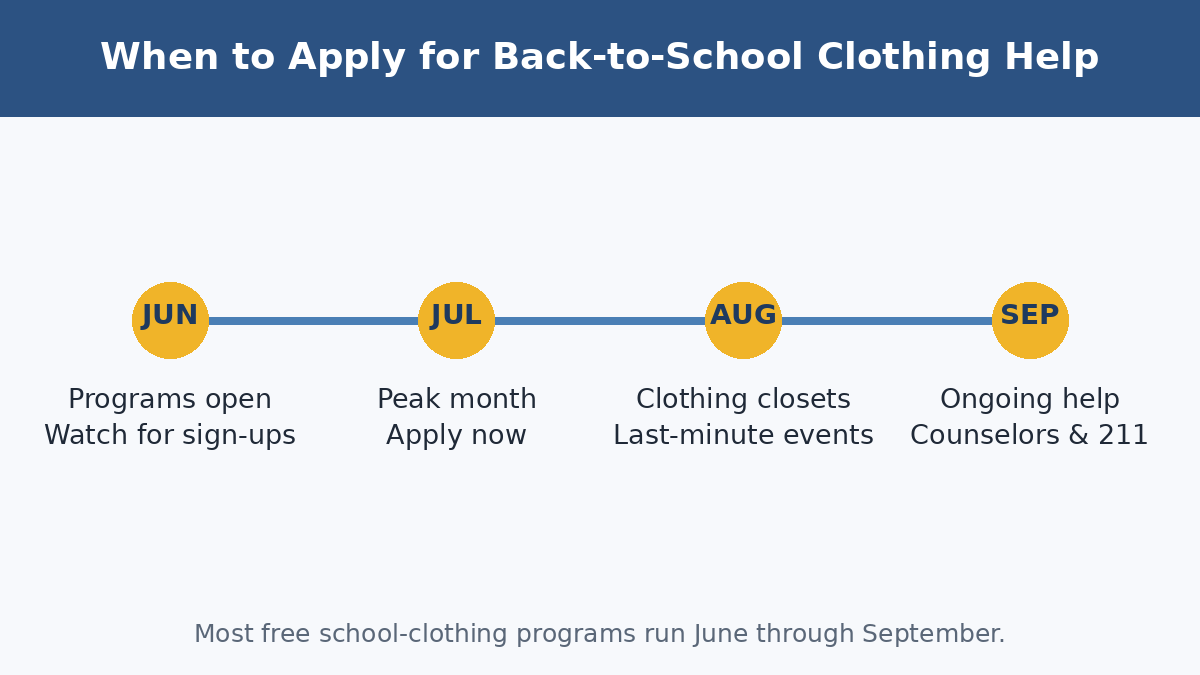
4. Apply early. The majority of these programs run from June through September and serve families first-come, first-served. Registering in June or July gives you the best odds before supplies run out.
5. Stack your resources. These programs aren’t mutually exclusive. A family might combine a charity clothing package (Operation School Bell), a state TANF clothing allowance, and a Buy Nothing group for extras — and ask each program about recurring help, since kids outgrow clothes quickly.
Who Qualifies for Free School Clothes?
Eligibility differs by program, but a few patterns hold. Most charities and government programs use the Federal Poverty Guidelines as a benchmark — common income cutoffs run from at or below 150% of the poverty line (typical for the Salvation Army) up to 200% (Cradles to Crayons). Some school-based options, like a clothing closet, serve any student in need without formal income proof. And certain groups qualify almost automatically: students experiencing homelessness are covered under McKinney-Vento, children in foster care have a state clothing allowance, and DEERS-enrolled military dependents can use Operation Homefront. If you’re unsure, apply anyway and ask — thresholds and definitions vary, and many programs would rather help than turn a family away.
Need more than clothing? If you’re stretched across rent, food, and bills, see charities that give money to individuals. Single moms can also check grants for single mothers and charities that help single mothers.
Frequently Asked Questions
How can I get free school clothes for my kids?
Start with your child’s school counselor and ask about Operation School Bell and a school clothing closet, then call 211 for local programs. National nonprofits like Cradles to Crayons and Baby2Baby, and the Salvation Army, provide clothing through partner agencies. Homeless, foster, and military families also have dedicated programs.
What income do I need to qualify for school clothing assistance?
Most programs use the Federal Poverty Guidelines. Common thresholds run from at or below 150% of the poverty line up to 200%, though the exact cutoff varies by program and state. Students experiencing homelessness qualify automatically under McKinney-Vento regardless of income documentation.
When should I apply for back-to-school clothing help?
Most free school-clothing programs operate from June through September and serve families on a first-come, first-served basis. Apply in June or July, because spots and supplies are limited and popular programs fill quickly.
Can I get free school uniforms?
Yes. Many school clothing closets, Operation School Bell chapters, and local charities and churches provide school uniforms. Your child’s school counselor is the best first stop, since many schools keep uniforms on hand or partner with a nearby program.
Do these programs help with shoes too?
Many do. Operation School Bell, Cradles to Crayons, and clothing-voucher programs frequently include shoes along with clothing. Ask each program specifically what’s covered, since some focus on clothing only.
What if there’s no program near me?
Call 211 for hyperlocal referrals, ask your school about its clothing closet, and use Buy Nothing groups or Freecycle for free peer-to-peer clothing. National Giving Alliance and the Salvation Army work through partner agencies, so a local caseworker may be able to connect you even in rural areas.
Related Resources
You may also find these guides helpful:
- Free School Supplies for Kids
- Best Charities to Donate Clothes
- Free Clothing Programs for Struggling Families
- Charities That Help With Food
Written & reviewed by Atdhe Trepca, founder of Happy Productions and a nonprofit strategist. Program eligibility, amounts, and application steps in this guide were verified against each organization’s official website and public program pages in July 2026. Because many programs are administered locally, confirm the current details with the specific chapter, agency, or state office before you apply.